
I’ve spent 30 years in structured cabling system industry, and I’ve seen a recurring mistake: industrial floors trying to dress up like office data centers. There is a strange visual 'hustle' when a bulky, 42RU black 19-inch rack (EIA-310-D) sits awkwardly next to a streamlined PLC cabinet. It’s a total lack of cohesion. While the PLC cabinet shows exactly how industrial wire management should look—compact, rugged, and efficient—that massive IT rack feels like a foreign object, out of place and out of its depth in a harsh environment.
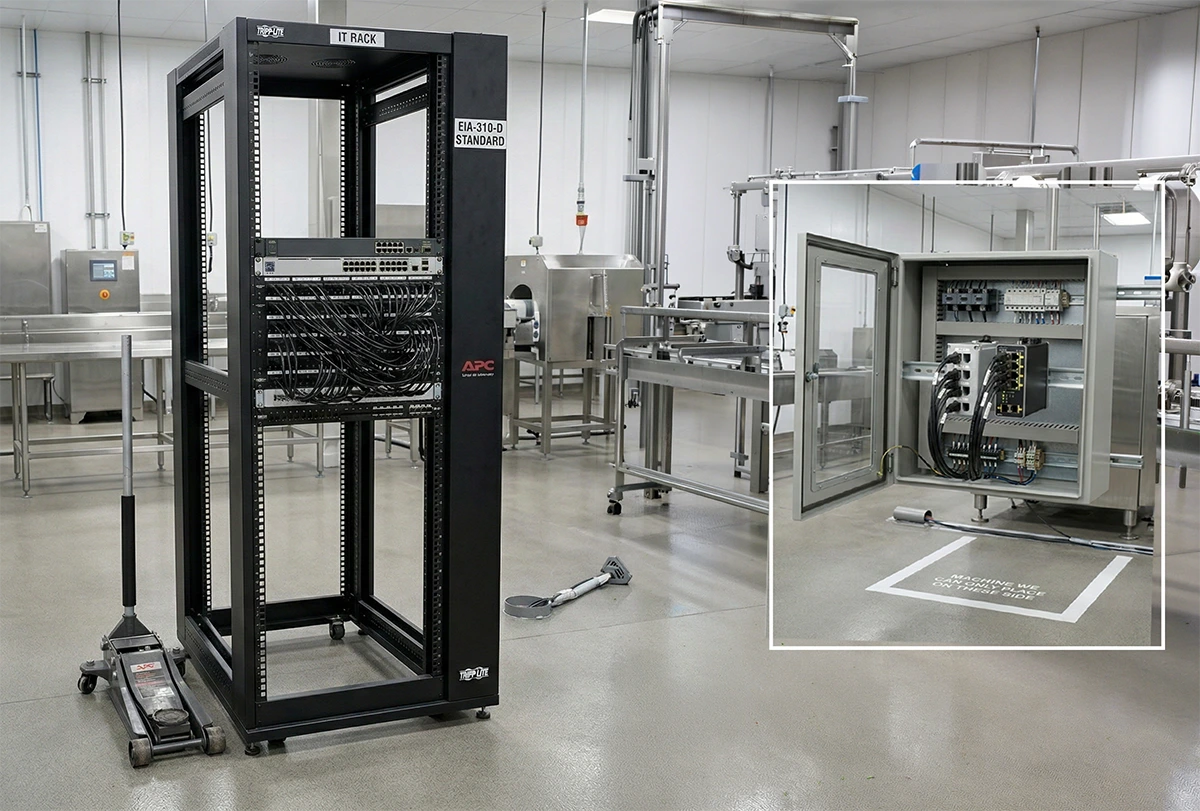
The footprint of typical 19inch rack in the production floor replace by an Industrial enclosure with serving only the active ports of Ethernet switch. See the significance space that has been saved?
The Fallacy of the "Big Switch"
" In my 3 decades, I’ve seen countless 48-port switches sitting in expensive 19-inch racks, gathering dust while only 4 or 8 ports are actually blinking. We call this 'stranded capacity.' By swapping that oversized IT switch for a rail-mounted Industrial Ethernet Switch (like the Cisco IE 1000), you aren't just shrinking the hardware—you're rightsizing the entire operation. You drop the footprint by 90% because you’re only paying for the ports the machine actually needs. "

Comparison of "The IT Habit" vs. "The OT Reality"
| Feature | The 19" IT Habit | The Industrial OT Reality |
| Port Count | 24 or 48 (mostly empty) | 4, 8, or 16 (optimized) |
| Cooling | Internal fans (sucks in dust/oil) | Passive/Fanless (sealed) |
| Cabling | Bundles of PVC "hustle" | Direct, oil-resistant runs |
| Cost | High "Floor Rent" per port | Zero floor footprint; integrated |
You see the clean, disciplined wiring of a PLC enclosure on one side, and then you see the 'wiring hustle' of a 42RU black rack on the other. It’s not just an eyesore; it’s a functional mismatch. The EIA-310-D standard was born for the server room, but the factory floor demands something tougher, smaller, and more integrated: the DIN rail.
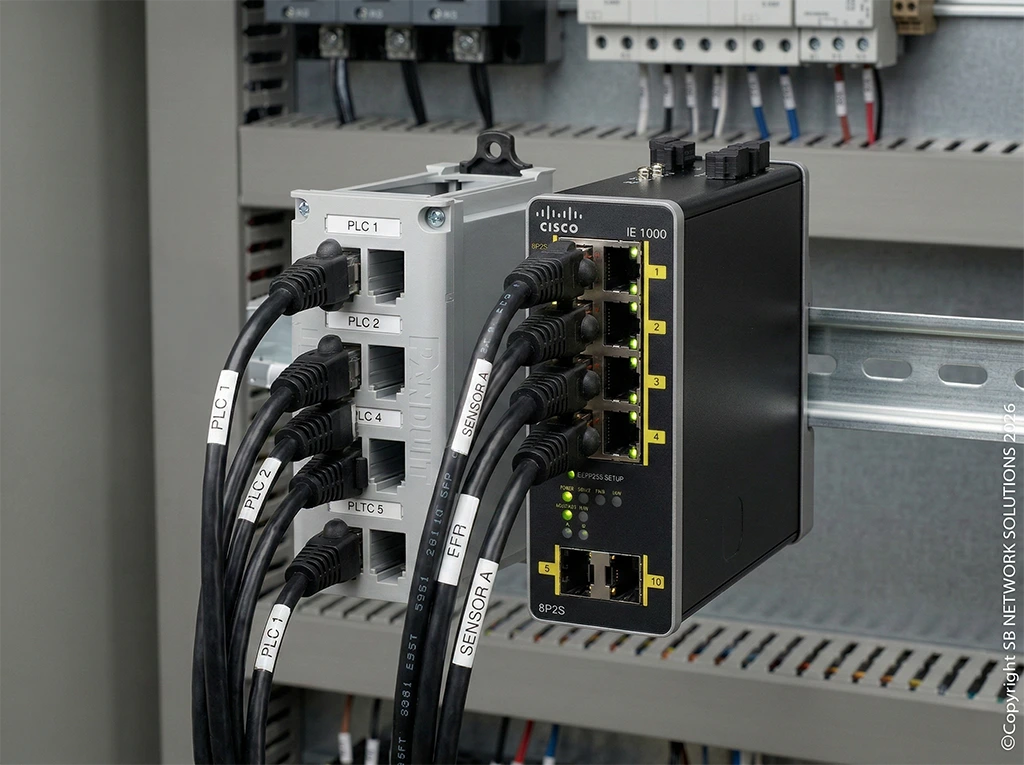
One of my former clients, a leader in the fast-growing food industry, recently challenged us to reclaim precious production floor space. They realized that the 'bulky black boxes' of traditional IT were eating into area better served by processing machinery. It was a classic case of the Industrial Engineer and the IT Manager being out of sync—like a dance pair who can’t find the beat.
To reclaim that precious space
While the 19-inch rack is the gold standard for climate-controlled data centers, it often fails in industrial settings due to footprint and accessibility.
Space Efficiency: Industrial control panels are shallow. A 19-inch rack requires significant floor space and depth. DIN rail components mount directly alongside PLCs (Programmable Logic Controllers), saving massive amounts of "real estate."
Vibration Resistance: DIN rail clips are designed to withstand the constant mechanical hum and vibration of heavy machinery, which can loosen traditional rack-mount screws over time.
The Hybrid Solution: If a 19-inch cabinet is already in place, mention using DIN Rail Rack Mount Panels. These allow you to mount industrial switches and media converters inside a standard rack, bridging the gap between IT and OT (Operational Technology).
| The 19-Inch "Off-the-Shelf" Rack | The Industrial DIN Rail Solution |
| Aesthetic: Bulky, Black, "IT-centric" | Aesthetic: Integrated, Compact, "OT-centric" |
| Footprint: Takes up valuable floor space | Footprint: Mounts inside existing cabinets |
| Protection: Designed for air-conditioning | Protection: Designed for oil, dust, and heat |
At SB NETWORK SOLUTIONS' industrial cabling service, we bridge that gap by offering industrial structured cabling components specifically designed for these environments.
Note: Original content authored by SB NETWORK SOLUTIONS; refined and optimized with the assistance of Gemini, an AI by Google.