
In the standard OSI model, the journey begins at Layer 1: The Physical Layer. For many organizations, this is where the first mistake is made: treating the cabling, racks, and cooling as a separate entity from the systems that run atop them.
When you split your infrastructure build-out and your system integration between two different vendors, you aren't just doubling your paperwork—you are creating a "Point of Failure" in your project management.
This separation is a strategic mistake.
When you decouple the physical build-out from the system intelligence, you introduce Vendor Friction, a hidden cost that can inflate project budgets by 15–20% through delays, change orders, and troubleshooting.
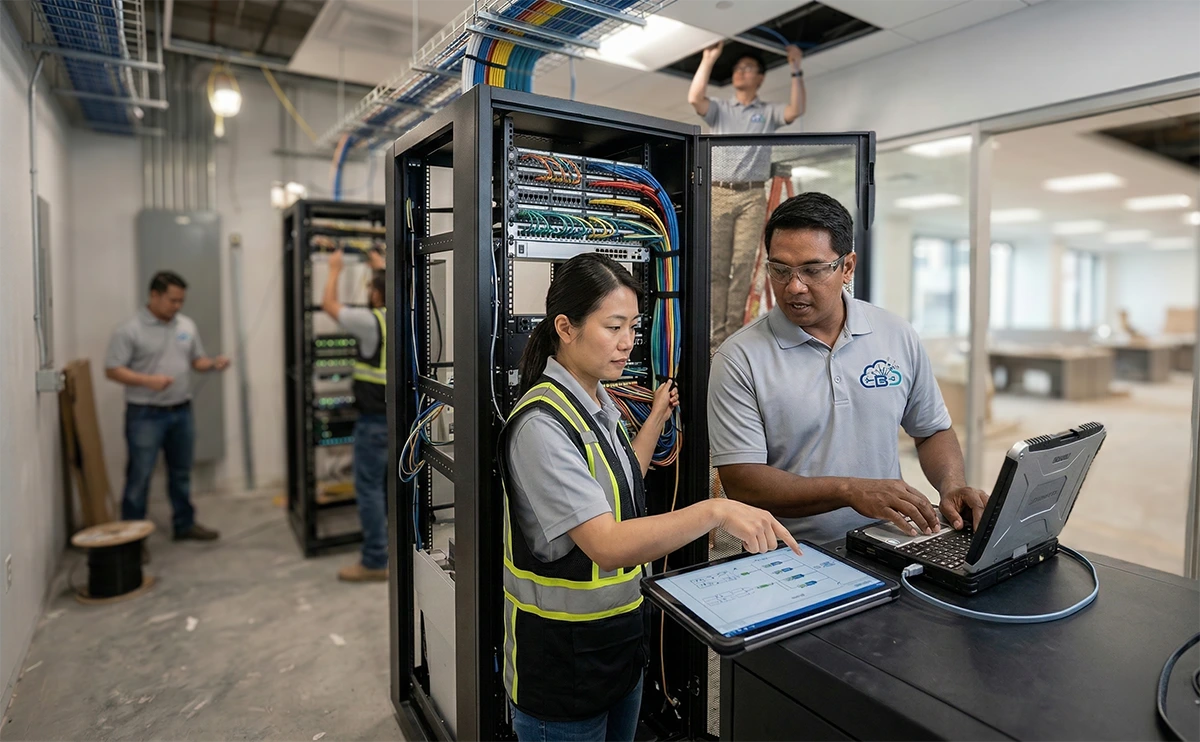
The Cost of the "Siloed" Approach
In a fragmented deployment, the client often becomes the default mediator between two technical teams with different priorities. This leads to several critical inefficiencies:
The Diagnostic Deadlock: When a network underperforms, the integrator blames the cable termination, and the cable contractor blames the switch configuration. Without a single point of accountability, troubleshooting hours (and costs) skyrocket.
Design Asymmetry: Infrastructure teams often build to general standards, whereas system integrators build to specific application requirements. If the physical path wasn't designed with the specific latency or power-over-ethernet (PoE) needs of the end-system in mind, the hardware will never reach peak performance.
Redundant Mobilization: Scheduling two different crews results in overlapping timelines, increased site disruption, and staggered delivery dates that delay your "Go-Live" window.
The Strategic Advantage of Integration
By consolidating Infrastructure Build-out and System Integration under a single partner, you transition from a "parts and labor" model to a "solutions-driven" model.
1. Holistic Design Verification
We don't just pull wire; we engineer the physical path to support the specific throughput of your integrated systems. Whether its high-density data center switching or complex AV-over-IP, the physical layer is built to the exact specifications of the logic layer.
2. Compressed Deployment Timelines
With a unified team, the transition from "Rough-in" to "System Commissioning" is seamless. As soon as the last fiber is spliced and tested, the integration team—who has been part of the same project briefings—is ready to initialize the hardware.
3. Single-Source Accountability
Our "Physical Layer to the Layer You Need" philosophy means one contract, one project manager, and one number to call. We take full ownership of the stack, ensuring that if a packet doesn't drop where it's supposed to, we fix it—regardless of whether the fix is in the closet or the code.
Efficiency is an Integrated Stack
Don't let your project get caught in the gap between the wall jack and the server. To ensure your next build-out is as robust as the systems it supports, you need a partner that speaks both languages.
We build the foundation. We integrate the intelligence. We own the result.
De-Risking Your Next Build-Out
Choosing a single partner for both infrastructure and integration isn't just about convenience; it’s about Risk Management. You are removing the "translation layer" where most project errors occur.
" We provide the "Physical Layer" your building needs and the "System Layer" your business requires—delivered as a single, cohesive asset."
Disclaimer:
Human-AI Collaboration: This blog post was authored by Nellix Cenizal/SB NETWORK SOLUTIONS with the assistance of Gemini AI. While the original "Physical Layer to Logic" theme and anecdotal context are uniquely ours, we embrace AI as a tool to help us deliver clearer, more insightful content to our clients.